
Inaugural Margaret Langley Memorial Address
October 23rd, 1999
Dr Harry Edhouse, (M.B., B.S., B.Sc.(Hons.), D.P.M., M.A.N.Z.C.P., M.A.Ps.S.), one of the founders of Marbury School, was formerly married to the late Margaret Langley. It was Dr Edhouse who devised the name "MARBURY" based, as he said "...in descending order of importance..." on the names MAR(garet Langley), BUR(rwell Dodd) and (Harr)Y (Edhouse). Dr Edhouse served on the Board of Governors of Marbury and is a prominent child psychiatrist who now practices in his home town of Melbourne.
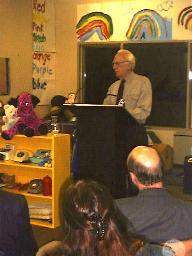
"I would like to thank the Board of Marbury School for the invitation to present the Inaugural Margaret Langley Memorial Address. It is my wish to, honour the past, commend the present, and provide stimulus for continuation into the future.
I will open this address by referring to Margaret's personal and family background, as her commitment to the establishment and operation of Marbury school draws meaning directly from that source.
Margaret was the eldest of five children of John Langley and Vera Savige. Neither of these individuals was satisfied with the state of society at that time, and both were dedicated to making changes. The chief forum for this drive was in their many years of connection with the Rationalist Society of Australia, for which John and Vera were founding members, and John was its long time Secretary and key public persona. John Langley was renowned for his erudite, analytic, and courageous lecturing and debating style. The Langley household was characterized by on-going vigorous discussion of social issues, with a steady flow of notable people visiting, and no doubt, enthusiastic development of strategies to spread their social message, and to deal with the opposing and reactionary forces in society. The ordinary concerns of other folk, for possessions, for material security, for things, - were not of concern to her parents. What was of concern, was 'the truth, the right path, the compelling argument, the commitment to a cause, loyalty to fellow-travellers, and the courage to do battle with the opposition'. As a growing child, Margaret believed that the work her father was doing was of the utmost importance for society. So it can be assumed that the 'social activism' concept was well imprinted in her early childhood as the model for 'what you do' as an adult in society.
Margaret Langley was thus attuned to living, thinking and acting outside the mainstream. She left secondary school early to join the work-force. Again, not following tradition, she returned to school attendance, as a young adult, taking impudent delight in re-attending normal school, in uniform, at twenty-five years of age, to pursue her Matriculation studies. Further steps away from the conventional were taken when she attended the National Gallery of Victoria as an Art Student, and these studies brought her into close and lasting contact with the artist groups and associated individuals who were active in Melbourne at the time, and who are now world renowned. In this climate she also encountered breakaway ideas on education, as a process in itself, and as an on-going life experience. She was exposed to living examples of home-schooling and small-group schooling for children, and had exciting involvements in communities of people adhering to a central ethos and organized around a charismatic leader. This resonated strongly with her childhood conditioning, vividly authenticating that experience, and broadening her outlook onto more than just the Rationalist cause.
A further particular focussing factor was her experience as a young parent. Being determined to provide her eldest daughter with the primary schooling which was closest to her ideals, Margaret had many years of contact with Preshil, the non-conformist progressive school in Melbourne. Over the years, it eventuated that all but the youngest of our children had some contact with Preshil before we moved interstate. So, many years later, when the right opportunity finally came along, Margaret was well primed and fitted to move into the development of a Progressive School.
It is now a matter of history, and sheer good fortune, that, at the time when we felt the need to become personally active in the educational scene, we became associated with the talents and dedication of Burwell and Joyce Dodd. Without these two, our ideas would have remained ideals. Together we formed 'a gang of four', aiming to bring about a working example of an optimal educational environment. The close interaction between us brought about a richer idea-base, and some invaluable know-how. Over the space of twelve months our initial preparations were complete, and in 1971, the commencement of Marbury School was announced, and recruiting of staff and interviewing of families was begun, and the School was established in Wayville.
Marbury School was a breakaway social innovation in the Adelaide educational climate at that time, was advanced in educational theory and practice, had a strong connection with the psychology of learning as such, and a particular focus upon the psychology of the learners as individuals. It was an endeavour in which hands-on, and sometimes gloves-off approaches, would be needed. Margaret's personality had these attributes in abundance.
Contemplating the spirit of Margaret in the School, - I can speak from personal experience in the early years of Marbury school, though it is from the perspective of a 'behind the scenes' observer rather than as a participant in the day-to-day running of the school. I could see that Margaret had a tenacity about getting the fundamentals right, and an ability to use all of herself, physical, mental, and emotional, and her considerable political skill and power in achieving that aim. Her particular skill was being able to burrow in to the middle of complex and emotionally charged interpersonal exchanges, and direct the flow, to convert actual or potential chaos and confusion into something orderly and productive. In addition, she was well able to dominate and lead small groups, and in this skill she was a charismatic leader to her colleagues. She was aware of the importance of teaching by example, not just as a noble precept, but as the most effective strategy, since a willingness to do anything, anywhere, anytime, both lowers the barriers and sets the modus operandi, - at one and the same time both encouraging and challenging others to extend themselves as fully.
To be able to debate at the highest level and also to scrap at a bare-knuckle level, covers the field and corners the options, and the whole of her background made a contribution to this faculty. It is not of much use having high ideals and noble aspirations if one hasn't the political will to conjure these into place, to develop in the school staff and students the ability to cooperate to this end, and finally to sustain the whole arrangement by unremitting effort, and the willingness to undertake some personal sacrifice to achieve this end. These lessons were well taught and well learned from her early family experiences. For myself, from the beginning of my training and work in Child and Family Psychiatry and Psychology, I had become aware of the three major sources of preventable problems, - the home and family, - the school, - the social environment. My main motivation for professional training in Child Psychiatry was a desire to enquire back and back into the beginnings and sources of life-problems. At the outset, that experience was, for me, not unlike reading a never-ending mystery novel, working towards the dénouement of the final chapter 'when all would be revealed'. However, in Child Psychiatry practice, it was sobering to encounter a vast sea of problems, many distressing in themselves, and many particularly distressing to me, because the remedy was so close at hand, with the main players in the production of the problem seemingly purblind to the solution. The excitement and the satisfaction in the clinical work of closing this gap, lay in seeing many of the problems resolve so readily. This helped me deal with the somewhat depressing scenario of the greater number of situations which had already proceeded too far to be rescued, and prompted me to think and look beyond the day's case-load. I arrived at the notion that the best use I could make of the problem material so delivered to me, would be to plough back into the family homes, the schools, and society, preventive messages. To this end I developed and delivered papers in public forums and to professional bodies on the general topic of the casualties of the home environment, the school environment, and the social environment, and presented strategies on how to prevent them. So it was with the great enthusiasm, that in 1970, some of the motivation from this source could be directed to the development of Marbury School.
My notion was that instead of clinics or schools for disturbed children, we could have schools that did not disturb children, - and Marbury could be an exemplar for that concept.
I have entitled the body of this presentation, "Family, School & Society, the Growth Pathway" . The interfaces between home, school, and the social environment, have often been a matter of barriers or hurdles, whereas common sense requires that these should be graded and overlapping experiences, geared to the needs of the individual child.
We want the early home parenting to be optimal, and we don't want this messed up by the schooling system, and we don't want society intruding consumeristically into the school years, particularly the primary years. Ideally, Family, School & Society should be a smoothly flowing growth experience.
Family Considerations
It is a matter of common knowledge that all of the most important potentials and limitations are already laid down by the time the child reaches school. But, a person will not grow out of a newborn of its own accord. So, what are the factors of importance in this area? How do you grow a person? What is the formula for person-making? How does raw data about the world turn into information,into learning, into knowledge, into skill, into some real world application, into wisdom? What is the mechanism for this? What conditions are needed? The answer is simple, - a grown adult and a growing child working closely together, making the parents the first and most important teachers. We will start the analysis where it all begins, where the principles involved are crystal clear, where the lifelong style of becoming a person and learning how to learn is being set. Let us put this under the microscope, as the lessons are profound and far reaching.
When the babe pops into our world it has quit the uterine world where there has been, in the normal situation, a mother/foetus harmonious working-together system, where all needs are met, on time, in the right dose. Rather suddenly, at term, the foetus is ousted from floating comfortably in an amniotic tank, to emerge suddenly, and rather shaken up, into a vast turbulent sea of new experience, crammed with bright lights, un-muted sharp sounds, the absence of the cushioning hydrostatic pressure, the presence of irresistible gravitational and other forces, and sudden temperature changes, - a tidal wave of new sensations and experiences.
For the new-born, actualisation of potential resides in the efficacy of the mother/child interaction. This needs to pick up seamlessly from where it was temporarily interrupted by the birth process. Initially, skin to skin, body to body, encircling arms, voice to ear, eye to eye, and nipple to mouth, and mind to mind, are the essential ingredients in this interaction. Given full and accurate ministrations, from birth onwards, there is set in train a process of shaping and conforming of the total organism of the babe to these interactions, and hence to the care-taking person. But, from this moment on there also exists, the possibility of a devastating lack of a sustaining environment, or the overwhelming presence of noxious experiences.
The matching of need and response is critical. From this moment on, the life-long nervous system setting will be edged towards the green tranquil zone, or the amber anxiety/apprehension zone, or the red dys-control danger zone. Clearly, at birth, every effort should be made to lessen any shock reactions by receiving the babe into an 'environmental womb', to enable the closest possible smooth transition to its new existence. We want the babe to feel welcome in the new environment, and to be consequently welcoming of the new environment. We need this 'environmental womb' circumstance to continue for many months, fully supported by family-network & social arrangements, with both mother and babe cushioned from external exigencies. This 'optimum welcoming response in relation to new experience', resulting from harmonious working-together is the quality of being to be set in place in the babe, - a trustful openness to new experience. This is the dynamic we would like to see operate, in infancy and early childhood, in the pre-school and school epochs, in the later engagements with the social world of peers and people, then further on in the forming and maintaining of adult relationships, in evolving vocational activities, in the exploration of and contribution to the world, and finally in the act of parenting of the next generation.
The dynamic is, - Co-Operation, Co-Operation, Co-Operation, ie, a grown adult and a growing child operating together.
Peering even closer with our microscope we perceive that, the human babe is, not geo-tropic as are plant roots, nor helio-tropic as are plant shoots, nor instinct-equipped to cope without assistance, as are chicken or turtle hatchlings. The human babe is uniquely dependent on the quality of the care-taking, and - to coin a phrase, is 'responso-tropic'. This is both the vulnerability and the strength of the human newborn, where things can go very wrong or very right. This protracted dependency is designed by Nature for a specific purpose. Space and Time is required for its full utilization, for Mankind's Species Pre-eminence in Language and Consciousness to be acquired. Baby brains are hungry and thirsty, greedy for input, sucking up data about the world, transforming it into the building bricks of the personality. This vital growing tip of the babe will follow the response it gets, and be shaped by that response. If its needs are accurately met by the mother, then its development conforms to her way of being. If the needs are under-responded to, then development will be inhibited (comprising a developmental delay), or will turn inward (comprising inner turmoil), or will turn toward other aspects of the environment (comprising non-social leanings).
So let us press on. The latest research shows that neurologically, the infant brain is 'neuro-plastic', it is as yet, un-wired, not yet connected up. There isn't a learning machine already resident in the brain, waiting to absorb knowledge. The learning machine itself is grown by the parental-care actions, and the conditions and circumstances provided. It is learning how to become a learning machine. The brain is being 'hard wired'. Neurones actively engaged are connected together. Unused neurones are pruned away. Learning ability is being manufactured. Almost un-noticed, a family version of the History of Mankind, of Life's Meaning and Purpose, is being installed. Wisdom and Stubborn Ignorance, Great ideas and Prejudices, are going in - side by side. The mentality is being sharpened, or blunted. We err, if rushing or blurring this opportunity, in leaving it to chance. One could go on, detailing the responsive changes with this or that experience, but, for this presentation, I am merely wishing to establish this process as the primary model for understanding and managing much of the later happenings in our area of interest, - Learning and Developing.
This is the Co-Operation model, - ie, a grown adult and a growing child working together.
School Considerations
Tracing this fundamental learning model further, beyond three to four years of age, into the place of the parental care-taker there steps the play-group leader, the kindergarten teacher, the school teacher, - but the transaction remains the same. Growth takes place with and through the people who become significant to the cild. Once mutual responsivity is established, the person of the child is authenticated, the world of ideas and things can be readily explored, and almost any activity, from sheer fun through to intense study and enquiry proceeds at a faster pace. This is the common pathway for both personal development and for formal learning. Growing and learning are thus inextricably intertwined, - different words referring to the same phenomena.
How can the teacher and the school, pick up from the work of the parent and family, and become the growth and development agent for the child? How to continue the harmonious working-together relationship so that it becomes growth promoting and empowering for the child? We need to think of teaching as modified and extended parenting, and not as just teaching of content but as teaching-how-to-learn by means of learning together, and the teacher as an expert learner, still learning, and actively sharing those learning skills. The teacher-child relationship, and the schooling environment, becomes the medium.
As the child learns how to learn, knowledge equates with pleasure, understanding with enjoyment.
Quality interaction gives Quality outcome. The absence of this pleasurable Co-Operation generates problems of performance and adjustment, - boredom, passivity, withdrawal, isolation, depression, learning difficulties, oppositionalism, antisocial group affiliation, truancy, school refusal, performance anxieties, fear of failure, competition traumas, and other casualties. If the relationship fails, the learning falters.
Let us delve back into Marbury history. In 1975, four years after Marbury School had started, both Margaret and myself presented papers on Education & Behaviour to a biennial conference of the Crime Preventive Council, the conference theme being Kids & Crime. Margaret's words from the opening section of her paper are:- "The notion of a non-authoritarian, non-punitive school is one that attempts to free children from arbitrary restraint and unnecessary rules in order that they can develop in their own way and at their own pace as individuals and as members of a community." Margaret was at pains to point out at this conference, that "non-punitive" entails a particular type of discipline, whereby children conform willingly to a benign authority, to be demonstrated day-in and day-out by all of the staff being willing to work through problems of adjustment or relationship, together-with the child. This was distinguished from the more common authoritarian approach where the erring child was coerced, condemned, punished, banished, made to feel a guilty, unfit member of the group.
In Margaret's hands, the implementation of this benign authority in Marbury School entailed a constant workshopping of the fundamental principles at a staff level. She believed that the staff members must confront where necessary, their own personal issues relating to these principles, and make the necessary steps of development in themselves in this area, in order to present the children with the welcoming openness and consistency that ensured their trust and willing cooperation. She believed Maria Montessori's principle "that all growth must come from a voluntary action of the child himself, the learner must do his own learning", and that the teacher's rôle in facilitating or not-obstructing this process entails continuing work upon themselves.
Seemingly incongruous in a non-punitive, largely permissive environment, was the tenet Margaret developed early in the management of the schooling community, that "you must obey your teacher". The balancer to this injunction being that all decisions could be brought to a community forum for discussion, - which sometimes put the teacher in the hot seat, but which was a splendid active-participation lesson in responsive and responsible community living. (We could quote here from Trevor Tomkins "Good education is not just finding the answers to the questions - it is
also questioning the answers.")
Margaret believed that the acquisition of the more formal educational material proceeds fastest and best when these matters are settled, and the learner's mind is not cluttered with unresolved relationship issues. She concluded her paper with the words:- "In my experience, children in the main desire to grow in a healthy fashion and only require the right conditions to be provided in a caring and structured environment, geared to their developmental needs, for this to be achieved."
My own experience at that time, and as expressed in the paper I presented to that same conference, seems, on re-reading to be as relevant today as then. I still see casualties from all levels from the Kindergarten to the University. There are still practices of forced separation at kindergarten entry and at school entry, despite the long-standing knowledge of the persistence of Separation Anxiety reactions from this source, and there are still punishments for unacceptable behaviour, - Time Out, Deprivation, Extra work, Detention, Segregation, Suspension etc., - all examples of the lack of the grown adult and the growing child hanging in there together until a solution is found.
Children walk in through the school gate as little packages of genetic tendencies and as a log-book of how these tendencies have been responded to. They bring needs for individualised responses, and a potential to gravitate towards, and to develop well with, those who respond to their needs best. If they have already had the experience of gain from close relating to their home adults, then they will be ripe for influence and guidance by their teacher, and less liable to be swept away by peer group gang-pressures, and less caught up in consumer-oriented social influences. With teacher/child relationship matters settled, the next requirement is to provide a rich and interesting 'schooling-for-life' environment, to foster group enthusiasm, to nourish joy in participation, and a to cultivate experiencing pleasure in one's own progressive growth and development. The remaining challenge is to produce a curriculum in a format, and presented in a style, that subserves this aim, - and heeds society's requirements, --- in that order.
A nine-year old old boy said to me, "My stomach doesn't want to go to school, but I want to go to school. It's against me. The bottom half is beating the top half." A good description of an interface problem, the question being the readiness of the child to leave home and the readiness of the school to welcome the child who leaves home.
Society Considerations
Now, what shall we say about society? Wonderful, amazing, degenerate, traumatizing! Miracles of discovery and invention, vast supplies of information and knowledge, deepening cesspools of death, destruction, vice and greed.
Since the baby born today is not substantially different from the baby born many thousands of generations ago, each new individual has to accomplish much, much more, to bridge the gap between the primitive needs which still demand the same fulfilment, and a society which has rocketed away from that original circumstance. Some couples, in starting a family, continue unchanged after becoming parents, refusing to allow the presence of a child or children to alter their habits of mind, or their life-style, or to interrupt their career or material aspirations, and thus they become a parent-statistic, but not parents-in-attendance.
Here is a case-vignette for a situation presented to me in my practice recently.
"An eleven-year old girl, we shall call ,"Mary-Lou", second of four children, who is driving all her family to distraction with her need for physical and emotional contact with them. (The early history was that Mother breast-fed her to three months of age, and then returned to work. There followed several medical problems in infancy entailing traumatic hospitalisations etc, which experiences resulted in the toddler being unable to settle and constantly coming to parents' bed at night when she was two to three of age. This was... 'cured'... 'in one week' ... by tying shut the dividing door in the passage and turning up the music, whereupon the distressed child slept the night on the carpet by the door). 'Mary-Lou' told me that all four children of the family now have rooms of their own, and she has a radio, a CD player, and a TV, a VCR, a Game-boy and a Nintendo in her room, and the family has six TV's in the house altogether. Both parents work of course. In this case we have an oversupply of things, and an undersupply of personal contact.
And another recent and similar example :-
Just a few weeks ago, a family attended, arriving in two cars, Mother in a business suit holding a diary, Father in overalls carrying a mobile phone, boy walking separately, head down, cap over eyes, thumbs operating an electronic game. History of retention as a newborn in maternity hospital after Caesarian for "not feeding". Bottle-fed difficult infant (feeding, sleeping, crying problems). Family Day Care from twelve months, multiple care-takers since, traumatic family break-up, now in reconstituted family of three children, with new two year-old 1/2 sib, all children in
before-&-after school care. Parental handling is indulgent/punitive. This boy made the parents and me wait until he reached an end-point in his game before joining me. He complains of parents not spending time with him, and said "Mum's on the Internet all the time", Reason for Referral- violent tempers, and talking of getting a knife and killing himself. I had thought that these case vignettes to be a telling enough comment upon the hazards in the contemporary family in our Western society, only to subsequently have referred a ten year- old girl, who became violently psychotic and required two weeks hospitalization after viewing a video at a sleep-over party. The children had been watching an unsupervised MA-rated violent video. All parties to this happening are now devastated, and some may well be permanently affected. These examples are illustrative of the toxic elements in the society in which we live, and the lack of protective factors in apparently normal homes and families. Maria Montessori, again, "It is the law of human life, as certain as gravity; to live fully, we must learn to use things and love people ... not love things and use people." In order to provide the best immunity from social contagion for our children, and to secure their optimal development, the need is to protect and consolidate the first five years of life experience. Schools need to pick up and share this responsibility, and provide a carefully graded set of bridging experiences between home and family and the external social and material world.
Hence, it is vital to fully satisfy basic personal and relationship needs, as they occur, every step of the way, along Family, School & Society, the Growth Pathway , to secure the robust personality development needed to withstand the noxious and destructive elements in our social environment, to develop the Co-Operation factor, to maintain togetherness, and to minimise exploitation.
Some Conclusions
The ideal schooling environment will provide the child with an integrated set of experiences from Kindergarten to Matriculation level, from his initial dependency upon others' responses, towards encouraging his independently carrying out tasks and projects, and developing aims for his post-schooling life. Adverse home experiences, traumatic introduction to schooling through mishandling of the separation experience, upsetting peer-group influences, exposure to under-controlled group experiences, or to pathological children or teachers, and the splitting of his Kindergarten, Primary and Secondary schooling into highly dissimilar and incompatible experiences, can turn the further development of the child into anti-relating, and anti-learning and anti-social pathways.
The teacher's task is to focus upon learning about each child, as this focus creates the most favourable climate for the child's development. The child will be interested in being understood, and reciprocally interested in the person who is acting this way. The teacher and the child thus develop a mutual interest in one another and in themselves, making then both learners together, and clearing the decks for later task-orientation and task-learning. Ideally the teacher, as an adult, has outgrown personal needs in the adult/child interaction, and should be not prone to being too-affectionate, too-rejecting, too-demanding, too-distant, too-angry, too-upset, too-sad, too-hurt, too-disappointed etc. To quote an educationist :- Prescott -"For human minds and behaviour can be controlled from without; or human minds can participate in shaping their own behaviour and destiny. If the individual is coerced and driven he will expect to coerce and drive others. But if the individual is encouraged by experience from his early days to actively discriminate for himself between behaviour alternatives on the basis of valid information and social values, then this will seem to him to be the natural way to decide things. If he lives among individuals who value and are considerate of him and of others, as well as of themselves, then he will regard it as right and proper to value and to be considerate of others." The small-sized, non-conformist, independent school, is in the best situation to arrange its structure and function organically, flexibly, according to the persons involved - ie the staff, the pupils and the parents, to allow for the happiest arrangement between the three parties concerned. Government schools and the more conservative independent schools are more committed to the needs of society, and more subject to economics and other pressures. The current move towards privatisation of schools as business enterprises is a mixed blessing, perhaps entailing 'every child is another dollar, vs every dollar is another child facility'. There can be a cost to the child if society's needs reach too deeply into the early learning environment, making the opportunity for optimal all-round development of children degenerate into a scramble and a pressure for high achievement, which can cause both teacher and student to become stressed and to drop out altogether. A balance is needed. Optimal child development and learning requires constant hands-on attention. This is the Co-Operation factor, - a grown adult and a growing child learning together. Less than this gives a lesser result, - sub-optimal learning and sub-optimal development.
Times change. The world changes. Newton would not be a Newtonian. Freud would not be a Freudian. Would Margaret be a Marburian, second time around? It is rare to find one such as Margaret Langley, so dedicated, so willing to make sacrifices significantly affecting personal and family life in the pursuit of a social reformist goal. She enjoyed and excelled in the rôle of innovator, diving in at the deep end, creating on the run, retaining what worked, discarding the rest. What does Marbury School now need? Simple continuation? Contraction? Expansion? Evolutionary shift in focus? Specialisation? Replication elsewhere? Preshil in Melbourne, founded some forty years before Marbury, is still continuing strongly as a vital and much needed part of the Victorian educational scene, and now has its fourth Principal, Dermot Lyttle, an ex-Preshil student and a current Preshil parent, and a great-nephew of the original Margaret Lyttle. A Lyttle dynasty! Its future seems assured. Penbank, in my own Mornington Peninsula area of Victoria, originally a parent-operated community school, established in 1974, moved to 9-acre site in 1979, is a non-sectarian, co-educational primary school, with eighteen children per group, and a total of 140 pre-school and primary children. A beautiful school in beautiful surroundings with successful happy children. Again, with a solid future.
Finally:-
From the child's view, Families are Forever, Schools are for an Interval, Life goes on for a Long Time thereafter. From the therapists' view, Bad schools cause casualties and perhaps destroy what was built in from the family. From the progressive educationists' view, Good schools protect unique family attributes, and add inspiration and extension.
One would like Marbury School to continue to provide, an expansion of the family engram already installed in the child, promotion of the values of personal self-discovery and growth through co-operation, and a secure route of entry for the child into existing society. That is, to continue as an educational phalanx in advance of the commonplace, for the socially aware to utilise and emulate.
Margaret Langley's Services to Education have been duly recognised by the Membership of the Order of Australia award.
Marbury School has an unique place in the educational spectrum. The pioneering has been done. The foundation has been laid.
A tradition can now be established."
Harry Edhouse.<edh@melbpc.org.au>